
How to Teach Cursive at Home (Without the Fight)
Cursive is coming back to school in several states. Yet in one large study, the fastest writers didn’t write in pure cursive. Here’s what that means for practice at home.
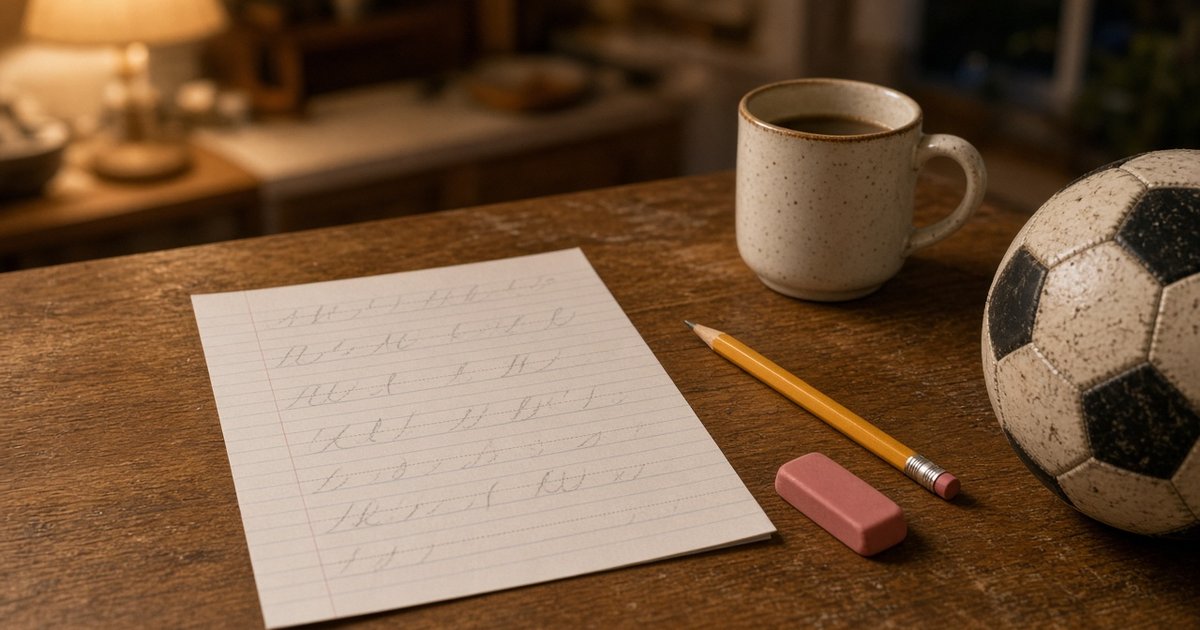
In a study of 600 students, the fastest handwriters weren’t the pure-cursive kids or the pure-print kids. They were the ones who mixed the two.
Cursive is back on the schedule
If your kid is in elementary school, cursive may be on the school schedule again, depending on where you live. Here is what three state laws say, checked against each state’s official text:
- California. A 2023 law, AB 446, requires handwriting instruction in grades 1 to 6 to include “cursive or joined italics in the appropriate grade levels.”[1]
- New Jersey. A law approved on January 19, 2026, requires cursive instruction in grades 3 to 5, so that students can read cursive and write it legibly by the end of grade 5.[2] The state’s Department of Education says schools start in the 2026–2027 school year.[3]
- Florida. A 2026 law, SB 182, in effect since July 1, 2026, requires cursive instruction in grades 3 to 5. By the end of grade 5, students must write uppercase and lowercase letters in cursive, write words and sentences legibly, and be able to read cursive.[4]
Rules differ from state to state, so if yours isn’t on this list, your state’s department of education is the place to check. Whatever the law says, kitchen-table practice is where a lot of handwriting actually gets done.
The fastest writers mixed print and cursive
In a study published in 1998, a team that included Steve Graham and Virginia Berninger collected writing samples from 600 students in grades 4 to 9 and sorted each paper by style: print, cursive, or a mix of the two.[5]
Students who used a mixed style wrote faster than students who used only print or only cursive. Papers written in a mix that was mostly cursive got the best legibility ratings. And pure print and pure cursive came out even, in both speed and legibility.[5]
So the aim at home doesn’t have to be perfect, textbook cursive. Joined letters are a tool, and many kids will end up with their own blend of joined and unjoined letters. In that study, the blended handwriting was the quickest.
Handwriting practice shows up in the writing itself
In 2016, Tanya Santangelo and Steve Graham pooled experimental studies of handwriting instruction with students from kindergarten to grade 12. Teaching handwriting made students’ writing more legible and more fluent. It also improved the quality and the length of what they wrote.[6]
One more result is worth knowing before you buy anything. In that analysis, motor instruction on its own did not produce better handwriting.[6] What helped was teaching handwriting directly, and tailoring instruction to the individual kid also made handwriting more legible.
What schools are told to do, translated for the kitchen table
In February 2026, New Jersey’s Department of Education sent schools guidance on how to teach cursive. It’s written for teachers, but most of it works at home too:[3]
- Teach it explicitly and in order, with plenty of guided practice before kids work on their own.
- Keep a model of each letter in sight while they practice, so the stroke order, the size and the joins stay right.
- Make sure letters are formed accurately and joins are fluent before asking kids to compose in cursive.
- When they start using it, aim for accuracy and legibility rather than speed or length.
- Reading cursive matters, and it should add to writing practice instead of replacing it.
That last point is easy to miss. Florida’s law also counts reading cursive as part of being proficient.[4] A kid who can read a handwritten birthday card from a grandparent gets something out of practice right away.
Letter, join, word, story
Put that guidance in order and you get a four-step route. It’s also the order of Soccer Stories in Cursive:
- Letter. One page per letter, uppercase and lowercase, with numbered arrows that show where to start and which way to go.
- Join. Practice connecting letters before writing whole words.
- Word. Seventy soccer words, including dribble, pinnie and scrimmage.
- Story. Eighty true soccer stories told in 160 sentences, to read in cursive, trace and copy onto lines with a dashed midline.
The fourth step is where the “without the fight” part comes in. Copying a sentence about a referee who showed himself a red card, or about Pickles, the dog who found the stolen World Cup, gives a soccer fan a reason to finish the line. That’s our view as the publisher of the book. No study has tested story-based cursive practice.
Keeping the peace
- Keep sessions short, and stop while it still feels easy. Our suggestion is ten minutes.
- Praise one specific letter: “That loop on your l is right on the line.”
- Go for accuracy first. Speed comes later, which matches the New Jersey guidance.[3]
- Let your kid choose the next word or story. Owning the choice makes the practice theirs.
Laws are verified. The method is a best guess.
How strong is this evidence? The three state laws [1][2][4] and the New Jersey guidance [3] were read at their official sources. The research is thinner. The 1998 study [5] is a snapshot of how 600 students already wrote; it shows that mixed writers were faster, but it can’t show that teaching a mixed style causes speed. The 2016 meta-analysis [6] is strong, but it covers handwriting instruction in general and doesn’t single out cursive. We found no trial of parents teaching cursive at home, and none of story-based practice. The four-step route follows the New Jersey guidance and the book’s structure, and the session tips are our suggestions.
The small experiment worth running tonight
Ten minutes, one pencil, and a sheet of lined paper.
- Read first. Write one sentence in cursive yourself, for example “The referee showed himself a red card.” Ask your kid to read it out loud. Help with the letters they can’t decode.
- One letter. Take the first letter of their name. Show it slowly, stroke by stroke. Have them trace it three times, then write it three times on their own.
- Their pick. Ask: “Which one is your best? Why?” Let them judge first.
- One join. Connect that letter to the second letter of their name. Stop there, even if it’s going well.
Tomorrow, try the whole first name. By the weekend, it might be a full sentence about soccer.
The game is the door. A good story is a reason to keep the pencil moving.
References
- California Legislature. Assembly Bill No. 446, Chapter 804, Statutes of 2023. Approved by the Governor October 13, 2023. Amends Education Code §51210. leginfo.legislature.ca.gov, AB-446
- New Jersey Legislature. P.L.2025, c.284 (C.18A:35-4.53), Cursive handwriting instruction in the grade school curriculum. Approved January 19, 2026. pub.njleg.state.nj.us, P.L.2025 c.284 (PDF)
- New Jersey Department of Education, Division of Teaching and Learning Services. (2026, February 11). Cursive handwriting instruction [Broadcast memo to local educational agencies]. nj.gov/education (PDF)
- The Florida Senate. CS/CS/SB 182 (2026), Education. Approved by the Governor April 20, 2026; Chapter No. 2026-33 (April 21, 2026); effective July 1, 2026. Amends s. 1003.42, F.S. flsenate.gov, SB 182 (2026) · Enrolled text: flsenate.gov, enrolled version.
- Graham, S., Weintraub, N., & Berninger, V. W. (1998). The relationship between handwriting style and speed and legibility. The Journal of Educational Research, 91(5), 290–297. doi.org/10.1080/00220679809597556
- Santangelo, T., & Graham, S. (2016). A comprehensive meta-analysis of handwriting instruction. Educational Psychology Review, 28(2), 225–265. doi.org/10.1007/s10648-015-9335-1 · Abstract: ERIC EJ1100680.