
What to Say to Your Kid After a Bad Game (Not ‘Good Job’)
Your kid already knows it was a bad game. What they don’t know yet is what you think of it. Here’s what the research suggests saying, and when to say nothing at all.
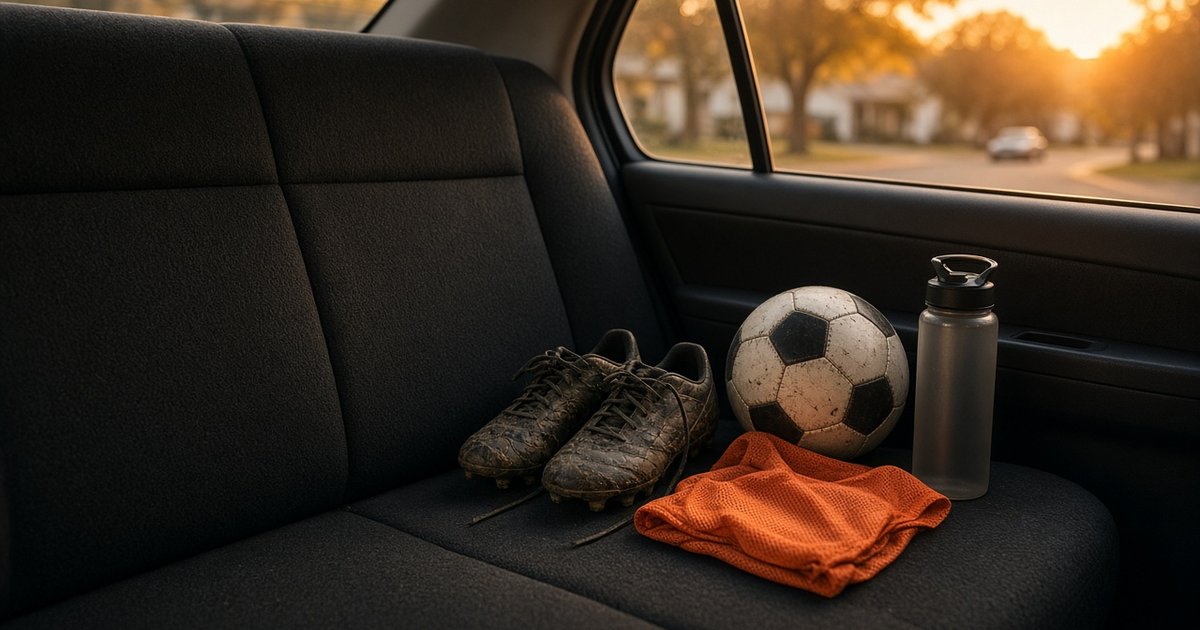
The most useful thing you can say after a bad game is usually nothing, at least for a while. Then let your kid go first.
Winning came in 48th
Researchers at George Washington University asked 142 youth soccer players, 57 parents and 37 coaches in the Washington, D.C. area a simple question: what makes playing sports fun? They ended up with 81 answers, and participants rated how much each one mattered.[1]
“Trying your best” came first. “Winning” came 48th in this study’s ratings. “Earning medals or trophies” came 67th.[1]
Keep that list in mind on the walk back to the car. The scoreboard you are still upset about sits in the bottom half of the list. Effort, a coach who treats players with respect, playing well together and getting playing time all ranked higher.
It matters for one more reason. The same paper reminds us, citing earlier research, that kids name fun as their main reason for playing and its absence as the main reason they quit.[1] What happens after a bad game is part of whether soccer stays fun.
Why “good job” sounds like a closing door
Your kid was there. So when you open with “Good job!” or “It’s OK,” you are asking them to agree with something they don’t believe.
Experts at Boston Children’s Hospital put it plainly: don’t be overly positive. If you tell your child it’s OK when they feel anything but OK, they may hear that you don’t want to listen.[4]
Players say the same thing in their own words. In interviews with 36 girls who played team sports, one of them said her own parents were “supportive but not to the extent of lying to you.”[2]
Praise is still welcome, as long as it’s true. “I loved watching you play” is true even on the worst day. “You played great” may not be.
| Instead of… | Try… | Why |
|---|---|---|
| “Good job!” (when it wasn’t) | “I loved watching you play.” | True on any day; honesty matters to players[2][3] |
| “It’s OK, it doesn’t matter.” | “That looked frustrating.” | Name the feeling instead of erasing it[4] |
| “Why didn’t you shoot?” | “What was the hardest part out there?” | Same topic, no accusation[3] |
| “Tomorrow we fix your first touch.” | “What do you want to work on next?” | Fixing things while they’re down will probably backfire[4] |
Four doors, no audience
A team at the University of Toronto interviewed 27 players aged 11 to 16, from soccer and other sports, and 26 of their parents, about one thing only: the car ride home.[3]
The same drive meant opposite things to different players. One group liked talking the game through on the way home. Another group dreaded it; the word they used was “endured.” A few said that the moment they made a mistake on the field, they started thinking about what they would hear in the car.[3]
The researchers point to privacy as the reason it can go either way. Some parents said they held their comments at the field on purpose. Teammates were around and they didn’t want to embarrass their kid, so the critique waited until the doors closed. That same privacy also made the car a safe place to talk about stress, coaches and teammates.[3]
Silence first, questions second
Timing comes up again and again. One girl in the study of 36 team-sport players said that when she is upset, her parents still try to talk in the car, and she answers: “Can we just talk about it later?”[2]
In the car-ride study, the first suggestion was “give time to think, and take time to think.” That works both ways: one parent admitted being “high on adrenaline” too, and saying things that came out wrong.[3]
Boston Children’s adds two practical points. Let your child do most of the talking. And when you do start, open the door instead of pushing through it, with a line like “When you’re ready, do you want to talk about what happened?”[4]
If there is something good to say, say it first. The girls in the team-sports study asked for positive comments first, then a couple of pointers, then more positives, and criticism only in private.[2]
Rules of the road, agreed before the next game
Plan the ride home on a calm Tuesday, days away from any game.
Some families in the Toronto study had set up their own “rules of the road” for post-game talks. One player had simply asked her mom to start with something positive. The lead researcher suggests asking your child directly: “How do you want me to act after a bad game?” and “Is there anything you do/don’t want me to say after games and practices?”[3]
Boston Children’s gives the same advice from the clinic side: set expectations in advance, and keep your post-game ritual even after a bad game. If it’s usually ice cream, it’s still ice cream.[4]
Two small studies are not a law of nature
How strong is this evidence? Moderate at best. The car-ride study (27 players) and the team-sports study (36 girls) are small interview studies from Canada, with players aged 11 to 16. They record what players asked for. Neither study tested whether giving them that makes the next game, or the next season, go better. The fun study [1] is larger and comes from U.S. youth soccer, but it measures what makes soccer fun, not what to say in the car. The Boston Children’s advice [4] is expert opinion. We found no trial that tests a specific post-game script, and no study of the car ride with 6- to 10-year-olds. Take this as a well-informed starting point, and let your own kid correct it.
The small experiment worth running tonight
Here is a script you can try after the next bad game. It is our suggestion, built on the sources above and on the four questions of the weekly training log in Soccer Training Journal for Kids: best moment, what the coach said, what was hardest, what to work on next. No game today? Ask your kid the two rules-of-the-road questions tonight.
In the car: one sentence, then quiet
- Say: “I loved watching you play.” Then stop.
- Music or a snack is plenty. Don’t bring up the mistake unless they do.
- If they want to vent, listen. Don’t fix, don’t coach, don’t trash the ref.
Later, at home: the four log questions, in this order
- “What was your best moment today?” Something good goes first, even on a bad day.
- “What did your coach say?” You learn what the team is working on, and you don’t compete with the coach.
- “What was the hardest part?” They name the problem. You don’t.
- “What do you want to work on next?” One thing, and they pick it.
Let them write the answers down in their own words, or write them for a younger player exactly as they say them. Then ask the two rules-of-the-road questions from the Toronto study and write those answers down too.
Next week: check the experiment
Before the next game, ask: “Last time, what helped and what didn’t?” Change the script. It’s your family’s now.
The game is the door. The ride home is a small, weekly chance to hold it open.
References
- Visek, A. J., Achrati, S. M., Manning, H., McDonnell, K., Harris, B. S., & DiPietro, L. (2015). The fun integration theory: Toward sustaining children and adolescents sport participation. Journal of Physical Activity and Health, 12(3), 424–433. doi.org/10.1123/jpah.2013-0180 · Free full text: PMC4201634 (Table 2, importance ratings). · Study location (Washington, D.C. metro area): GW Today, July 14, 2014.
- Knight, C. J., Neely, K. C., & Holt, N. L. (2011). Parental behaviors in team sports: How do female athletes want parents to behave? Journal of Applied Sport Psychology, 23(1), 76–92. doi.org/10.1080/10413200.2010.525589 · Author version: Swansea University repository.
- Tamminen, K. A., Poucher, Z., & Povilaitis, V. (2017). The car ride home: An interpretive examination of parent–athlete sport conversations. Sport, Exercise, and Performance Psychology, 6(4), 325–339. doi.org/10.1037/spy0000093 · Plain-language summary by the lead author: The Car Ride Home, SIRC, April 17, 2018.
- Barker, J. (2022, May 24). When athletes have bad days: Tips for athletes and parents. Boston Children’s Answers, Boston Children’s Hospital. answers.childrenshospital.org/athletes-bad-day